
Japan’s Newspaper Circulation Continues to Decline: Yomiuri Loses 470,000 Copies in One Year

By Tetsuya Kuroyabu
The decline in newspaper circulation in Japan continues. The Yomiuri Shimbun, which had a circulation of approximately 10 million copies in the 2000s and was listed in the Guinness World Records as the newspaper with the world’s largest circulation, lost approximately 470,000 copies over the past year. Its current circulation is about 4.9 million copies.
The newspaper circulation figures for August 2026, released by the Japan Audit Bureau of Circulations (ABC), show that the Yomiuri Shimbun lost approximately 470,000 copies compared with the same month of the previous year. The Asahi Shimbun lost approximately 120,000 copies, while the Mainichi Shimbun lost approximately 140,000 copies.
Circulation continues to decline across Japan, affecting both national and regional newspapers.The figures for Japan’s major national newspapers are as follows.
■ABC Circulation Figures for August 2026
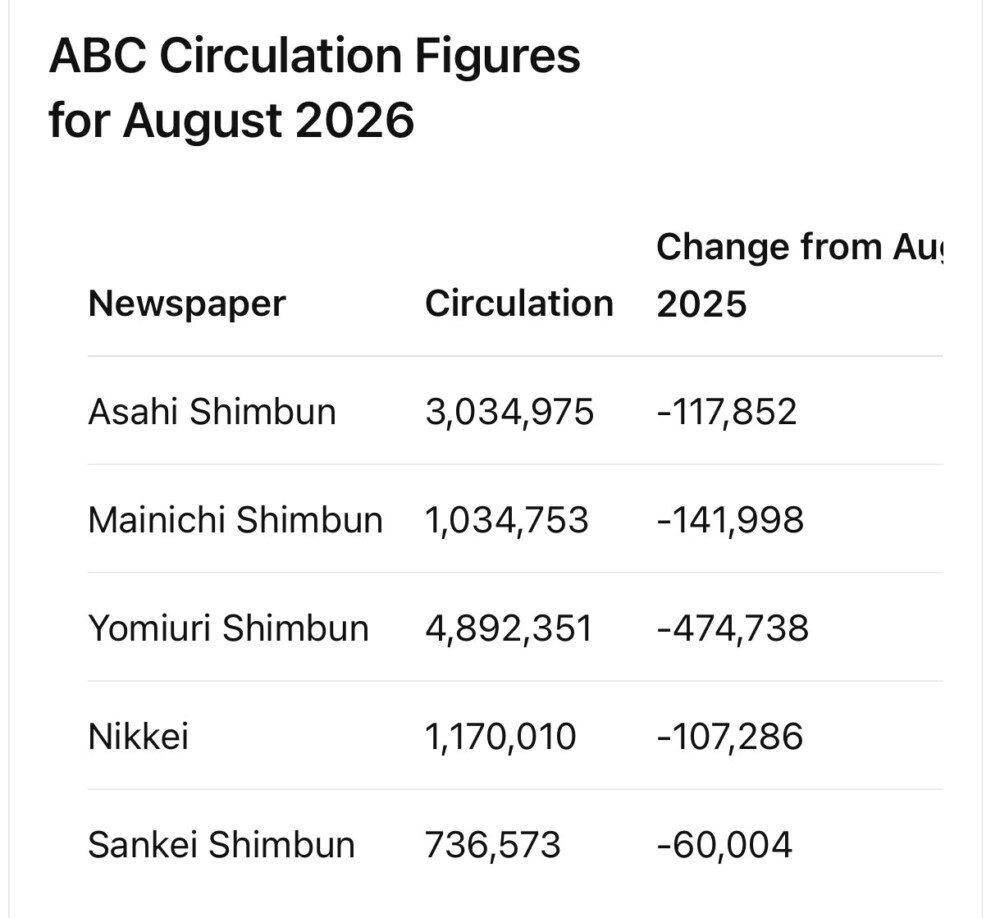
It should be noted that ABC circulation figures include copies that fall under the broad definition of oshigami. As a result, the number of newspapers actually delivered to readers is likely to be lower than the officially reported ABC circulation figures.
Oshigami is a Japanese term referring to newspapers supplied to newspaper distribution outlets but not delivered to paying readers. In Japan, newspapers are generally distributed through a nationwide network of local newspaper sales outlets. These outlets purchase newspapers from publishers and deliver them directly to subscribers’ homes. Under this system, newspaper publishers supply copies to local sales outlets, which are generally required to pay for the copies they receive.
The term oshigami, literally meaning “pushed newspapers,” is commonly used to describe excess copies supplied to these outlets, particularly when publishers pressure outlets to accept more copies than they need.
In a broader sense, the term also includes unsold or undelivered copies held by newspaper sales outlets, regardless of whether direct pressure from publishers can be established. The issue has been the subject of numerous lawsuits in Japan. Newspaper sales outlets have argued that they were required to purchase more copies than they could sell to subscribers.
In recent court cases involving oshigami, evidence has emerged showing that, at some sales outlets handling major national newspapers, between 30 and 40 percent of the copies purchased were not delivered to readers.This raises questions about the difference between officially reported circulation figures and the number of newspapers actually reaching subscribers.

■Circulation of Yomiuri Shimbun’s Western Japan Headquarters
The circulation figures for the Yomiuri Shimbun’s Western Japan headquarters, which is currently involved in the third phase of the Mamura litigation, are as follows.
* August 2026: 371,117 copies
* Change from August 2025: -31,895 copies
If circulation continues to decline at the current annual rate, a simple calculation suggests that it would reach zero in approximately 12 years.
Of course, this does not mean that circulation will necessarily continue to fall at the same rate. The pace of decline may change in the coming years.
However, these figures suggest that the network of local newspaper sales outlets, which has supported Japan’s home-delivery newspaper system for decades, is facing serious challenges to its continued operation. Japan’s distinctive system of newspaper home delivery is now at a major turning point.

